
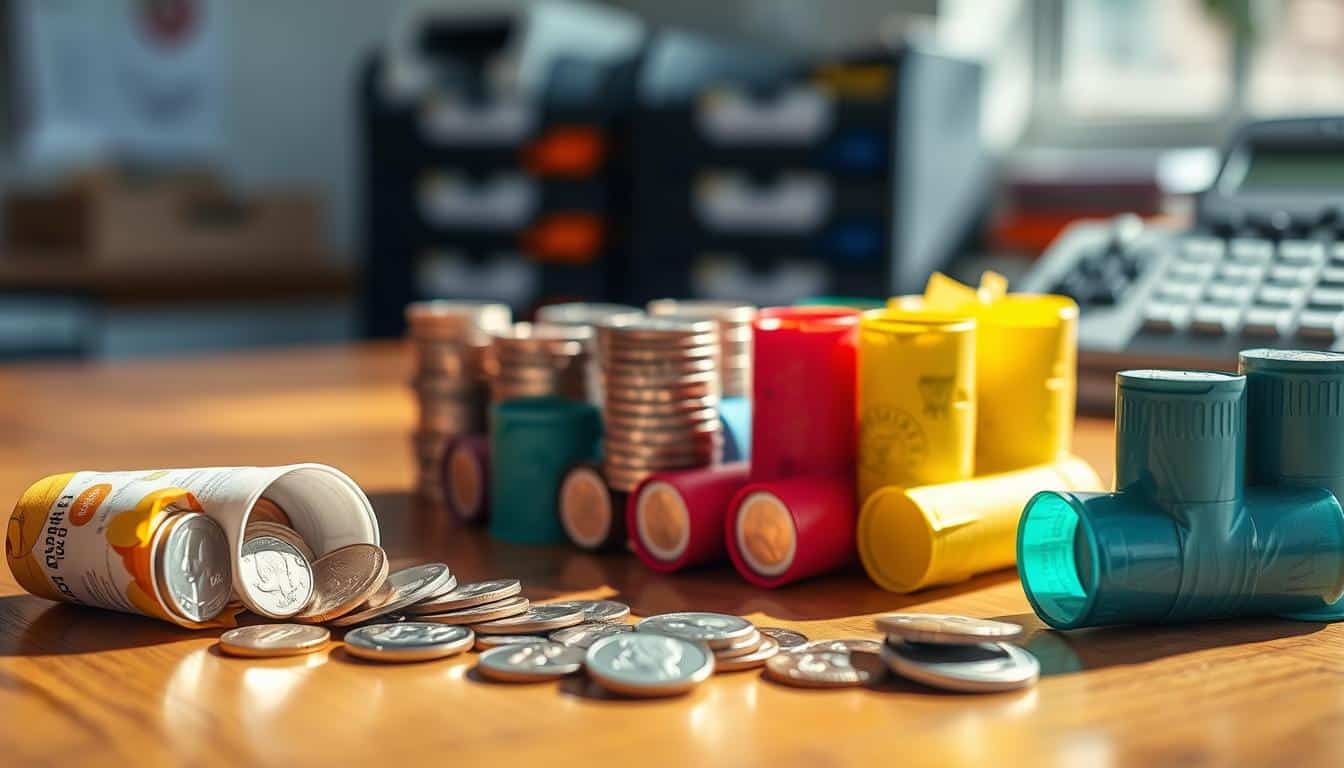
How to Use Coin Rolls: A Complete Guide
Americans hold roughly $48.5 billion in loose change sitting unused in jars, cars, and couch cushions. That’s enough to fill several Olympic-sized swimming pools with pennies and quarters.
I hauled three years’ worth of pennies to my local bank. The teller handed me brown paper wrappers. She suggested I organize everything myself.
That moment taught me about a currency-handling system. It has been standardizing banking transactions for over a century.
These paper-wrapped cylinders aren’t just convenient banking tools. They represent a practical solution for anyone dealing with accumulated change. This includes small business owners, parents teaching financial literacy, or someone cleaning their car.
This guide walks through everything from basic wrapper standards to storage techniques. You’ll learn which rolled coins your bank accepts. You’ll also discover how to wrap them correctly.
Collectors approach the process differently than everyday savers. Understanding these differences helps you handle your coins properly.
Key Takeaways
- Paper wrappers standardize currency handling across all U.S. banking institutions
- Each denomination requires specific wrapper sizes and quantity standards
- Most banks provide free wrappers but may charge fees for machine counting
- Proper wrapping techniques prevent rejection at bank deposits
- Collectors follow different standards than everyday banking purposes
- Home organization of loose change saves time and potential service fees
What Are Coin Rolls and Their Uses?
I’ve spent years working with coin rolls in various contexts. They’re far more interesting than most people realize. These simple paper or plastic tubes represent a standardized system that keeps our cash economy running smoothly.
Understanding coin rolls makes handling currency much easier. This applies whether you’re a business owner, collector, or someone organizing spare change. The banking industry has relied on this system for decades.
It creates efficiency that digital payment methods can’t entirely replace.
What Coin Rolls Actually Are
Coin rolls are pre-counted quantities of coins packaged in paper wrappers. They can also be stored in reusable plastic currency tubes. Each denomination follows specific standardized quantities that banks and businesses recognize nationwide.
The system eliminates guesswork and creates consistency across all financial institutions. A penny roll contains exactly 50 coins. Nickels, dimes, and quarters each hold 40 coins per roll.
The color-coding system fascinates me because it’s universally understood yet rarely explained. Banks use brown or red wrappers for pennies. They use blue for nickels, green for dimes, and orange for quarters.
This visual system speeds up identification during busy transactions. Paper wrappers differ significantly from plastic currency tubes. The paper versions are single-use and cost-effective for banks processing large volumes.
Plastic tubes can be reused indefinitely. I prefer them for personal use because they offer better protection during transport.
| Denomination | Coins Per Roll | Total Value | Wrapper Color |
|---|---|---|---|
| Penny | 50 | $0.50 | Brown/Red |
| Nickel | 40 | $2.00 | Blue |
| Dime | 40 | $4.00 | Green |
| Quarter | 40 | $10.00 | Orange |
| Half-Dollar | 20 | $10.00 | Yellow |
Where You’ll Encounter Coin Rolls
Banks use coin rolls for till management every single day. I’ve watched tellers prepare their drawers each morning by breaking open fresh rolls. This ensures they have adequate change.
The system keeps transactions moving efficiently during peak hours. Businesses depend on coin rolls for making change. Retail stores, restaurants, and service providers order them regularly from their banks.
Without this standardized system, daily operations would slow considerably. Vending machine operators rely on coin rolls more than most people realize. They need bulk quantities of quarters and dimes to restock machines and provide change.
The rolls simplify inventory management and transportation. Collectors use coin rolls for both storage and hunting. Roll hunting involves searching through bank rolls for rare or valuable coins.
This practice has become a popular hobby. The standardized packaging makes organizing collections much simpler. Regular folks use coin rolls when organizing spare change before depositing.
I’ve helped numerous friends roll their accumulated coins to avoid counting fees. It’s satisfying and saves money.
Why This System Still Matters
The efficiency factor cannot be overstated. Verifying a sealed roll takes seconds compared to counting 50 individual pennies. Banks process thousands of transactions daily, and this time savings multiplies significantly.
Standardization across financial institutions creates universal compatibility. A quarter roll from California works exactly the same in New York. This consistency supports interstate commerce and banking operations.
The coin roll system represents one of the most enduring standardization achievements in American banking history.
Organizational simplicity appeals to anyone managing cash. Currency tubes stack neatly in drawers, safes, or storage containers. They transform loose change chaos into orderly, countable units.
Theft deterrence provides an often-overlooked benefit. Rolled coins are easily inventoried and audited. Missing rolls become immediately apparent, unlike loose coins that might disappear gradually without notice.
The handling time reduction matters enormously in commercial settings. Cashiers can grab a quarter roll and break it open quickly. This beats counting individual coins from bulk containers.
It speeds up service during rushes. Despite digital payment growth, coin rolls remain relevant. Cash transactions still account for significant retail activity.
The physical nature of coins requires some organizational system. Coin rolls provide the most practical solution developed so far.
Types of Coin Rolls Available
Banks and office supply stores offer several distinct types of coin rolls. The variety might surprise you at first. Understanding these differences makes selection much simpler and prevents frustration.
The coin roll market divides into two main categories: standard rolls and specialty options. Most people only need standard varieties. Specialty alternatives help with collectible coins or long-term storage.
Common Standard Varieties
Standard coin rolls come in three main formats with distinct advantages. Each type serves different purposes. All three have earned their place in coin-handling tasks.
Pre-formed paper wrappers represent the traditional choice you probably remember. These flat paper sleeves require folding the ends after filling. They’re inexpensive and widely available, making them perfect for occasional use.
Pre-crimped paper tubes offer more convenience. One end comes already sealed at the factory. You only need to close one side after filling.
Bank coin wrappers typically follow this format because they speed up processing time. They save effort during busy periods. Many businesses prefer this style for efficiency.
Plastic coin tubes with removable caps provide the most durability. These reusable containers protect coins better than paper. They work wonderfully for transport and won’t tear unexpectedly.
Each coin denomination requires specific roll capacities and dimensions. Penny rolls hold exactly 50 coins, totaling $0.50. The copper-colored wrappers make them instantly recognizable.
Quarter rolls contain 40 coins and represent $10.00 total. Their orange or yellow color-coding helps distinguish them quickly. These rolls see heavy use in businesses with cash registers.
Nickel coin tubes also hold 40 coins but total only $2.00. The blue or green wrappers prevent mixing errors. Forty nickels carry substantial weight despite their small size.
Dime wrappers contain 50 coins worth $5.00 total. Their green color-coding matches traditional money associations. These thin rolls fit easily into pockets or cash drawers.
Less common varieties include half-dollar rolls and dollar coin rolls. Half-dollar rolls hold 20 coins worth $10.00. Dollar coin rolls contain 25 coins worth $25.00.
Paper quality varies significantly between manufacturers. Cheap wrappers use thin stock that tears easily. Bank coin wrappers employ heavier-weight paper that withstands rough treatment.
| Denomination | Coins Per Roll | Total Value | Common Color Code |
|---|---|---|---|
| Pennies | 50 | $0.50 | Copper/Red |
| Nickels | 40 | $2.00 | Blue/Green |
| Dimes | 50 | $5.00 | Green |
| Quarters | 40 | $10.00 | Orange/Yellow |
Specialized Options for Collectors
Specialty coin rolls serve purposes beyond simple currency organization. These premium options cost more but provide valuable benefits. Standard wrappers can’t match their protective features.
Archival-quality tubes use acid-free materials that protect valuable coins. Collectors prize these tubes for long-term storage. Standard paper contains chemicals that can tarnish or corrode coin surfaces.
Square-cornered tubes accommodate specific coin diameters with precision. Standard tubes work for most purposes. Serious collectors prefer tubes designed for exact measurements to prevent surface scratches.
Clear plastic tubes allow visual inspection without opening the roll. This feature proves invaluable when searching for specific dates or mint marks. You can examine an entire roll in seconds.
International-sized tubes accommodate foreign currency with different dimensions. Canadian quarters share similar size to American quarters. They require slightly different wrapper dimensions for optimal fit.
Specialty rolls cost three to ten times more than standard varieties. That investment makes sense when protecting valuable collectibles. Premium options justify their price for extended storage periods.
Choosing between standard and specialty varieties depends on your specific needs. Daily banking transactions require only basic bank coin wrappers. Long-term storage or collectible preservation justifies premium options.
How to Obtain Coin Rolls
I was surprised by how accessible coin rolls were when I first needed them. Most people think you need special connections or insider knowledge. The truth is simpler—you have several straightforward options, some completely free.
I’ve tested nearly every source available after years of working with coins. Each has distinct advantages depending on your needs and volume requirements.
Where to Buy Coin Rolls
Office supply stores became my first stop for organizing coins. Staples and Office Depot carry basic bank coin wrappers in their cash handling sections. They’re usually near receipt rolls and calculators.
Their pricing runs between $3 and $8 for a 100-count box. That’s reasonable if you need wrappers immediately.
Online retailers offer considerably more variety. Amazon stocks everything from basic paper wrappers to premium plastic tubes. eBay connects you with specialized coin supply vendors who understand collectors’ needs.
Dollar stores surprised me with their coin roll offerings. The quality isn’t premium, but they’re surprisingly decent for casual use. I’ve picked up boxes there for quick needs without waiting for shipping.
Bank supply companies sell higher-quality products designed for commercial use. They typically require minimum orders that might overwhelm individual users. If you’re processing coins regularly, the bulk pricing becomes attractive.
Coin collecting shops deserve special mention. They stock specialty tubes and archival materials that serious collectors prefer. I visit these stores for valuable coins that need better protection than standard paper wrappers.
Plastic tubes run approximately $10 to $20 for a complete set covering all denominations. That’s a one-time investment since they’re reusable, unlike paper wrappers.
Small business owners should consider buying in bulk to reduce per-unit cost. A 1,000-count box costs less per wrapper than ten 100-count boxes separately.
| Source | Price Range | Quality Level | Best For |
|---|---|---|---|
| Office Supply Stores | $3-8 per 100 | Standard | Immediate needs, small quantities |
| Online Retailers | $5-15 per 100 | Varies widely | Selection, bulk ordering, specialty items |
| Dollar Stores | $1-3 per box | Basic | Casual use, budget-conscious buyers |
| Bank Supply Companies | $15-40 bulk | Commercial grade | High-volume users, businesses |
| Coin Collecting Shops | $10-25 sets | Premium/Archival | Collectors, valuable coins |
Ordering from Banks and Credit Unions
Most banks provide coin wrappers free to account holders. I wish someone had told me this before buying my first few boxes.
The process couldn’t be simpler. Walk into your branch and ask at the teller window. They usually keep boxes of bank coin wrappers under the counter, ready to hand out.
Some banks limit quantities, typically one or two boxes at a time. Others distribute them freely without restrictions. Credit unions often have more generous policies than large commercial banks.
Banks provide empty wrappers for you to fill, not pre-rolled coins. If you need actual rolled coins for making change, that’s a different request. You’d be exchanging currency or making a specific withdrawal.
Establishing a relationship with your local branch makes this process smoother. Tellers are more accommodating when they recognize you as a regular customer.
Some branches keep multiple wrapper sizes in stock. Others might need to order specific denominations. My teller once ordered half-dollar wrappers specially, arriving within a week at no charge.
Obtaining wrappers is typically easier and cheaper than most people assume. Start with your bank if you’re an account holder. You might never need to buy coin rolls elsewhere.
The Value of Coin Rolls
I’ve always been curious about what the actual data reveals regarding coin usage across the country. Coin rolls represent significant economic value and reflect changing patterns in how Americans handle physical currency. The statistics behind coin circulation paint a picture that’s both surprising and informative.
Statistical Insights on Coin Roll Usage
The Federal Reserve reports that approximately 48 billion coins circulate throughout the U.S. economy at any given moment. That’s a staggering number. Of these, roughly 8 billion are pennies alone.
If we convert these figures into coin rolls, we’re looking at approximately 960 million penny rolls’ worth of pennies in active circulation. That doesn’t even account for quarters, dimes, nickels, and half-dollars. The sheer volume demonstrates how deeply embedded physical currency remains in our daily transactions.
However, the landscape is shifting. Banking industry data shows that coin transactions have decreased approximately 15-20% over the past decade as digital payment methods gained popularity. Yet physical coin usage remains substantial, particularly in specific sectors.
Small businesses, laundromats, vending operations, and parking systems continue relying heavily on coins. These industries process thousands of coin rolls monthly. Survey data indicates that the average American household accumulates between $50-75 in loose change annually, representing roughly 5-15 coin rolls.
| Denomination | Coins Per Roll | Roll Value | Equivalent Penny Rolls |
|---|---|---|---|
| Pennies | 50 | $0.50 | 1 |
| Nickels | 40 | $2.00 | 4 |
| Dimes | 50 | $5.00 | 10 |
| Quarters | 40 | $10.00 | 20 |
Trends in Coin Collecting and Trading
Despite declining everyday use, something interesting has emerged. Coin roll hunting—where collectors systematically purchase coin rolls from banks searching for rare dates or mint errors—has grown approximately 30% since 2020. Online communities sharing their finds have fueled this growth considerably.
I’ve noticed this trend firsthand through conversations with bank tellers. They regularly see customers requesting multiple boxes of coin rolls specifically for searching. The evidence suggests that certain date ranges carry premium value beyond their face amounts.
Collectors particularly seek these valuable specimens:
- Pre-1982 copper pennies (worth approximately 2-3 cents in melt value)
- Pre-1965 silver dimes and quarters (containing 90% silver content)
- 2009 commemorative pennies (four special designs marking Lincoln’s bicentennial)
- Error coins (doubled dies, off-center strikes, wrong planchets)
Market predictions suggest an intriguing possibility. As coin production eventually declines in response to reduced demand, earlier-date common coins may develop unexpected collector premiums. What seems ordinary today might become scarce tomorrow.
The systematic searching of coin rolls has proven potentially profitable for dedicated hunters. Some enthusiasts report finding silver coins worth 10-20 times face value in standard bank rolls. While such discoveries aren’t guaranteed, the possibility drives continued interest.
Coin rolls represent dual value—their immediate face value for transactions and their potential numismatic worth. Recognizing this dual nature helps you approach coin rolls more strategically. The real value manifests when you’re holding those wrapped cylinders in your hands.
How to Count Coins Using Coin Rolls
I’ve spent many evenings sorting jars of pennies, nickels, dimes, and quarters. The process taught me that efficiency matters more than speed. Proper coin counting turns an overwhelming task into a manageable routine.
Success comes from having a systematic approach. Randomly grabbing handfuls of change leads to frustration. The coin sorting process requires attention to detail but isn’t complicated.
I’ve refined my technique through years of rolling loose change. My current method takes half the time my early attempts required.
Step-by-Step Counting Guide
Following a structured sequence eliminates common mistakes. These steps create a workflow that prevents mixing denominations. They ensure accurate counts every time.
- Sort coins by denomination into separate containers. Mixing denominations is the most frequent error beginners make. I use four small bowls labeled for each coin type. This initial coin sorting step saves significant time and prevents frustration later.
- Create verification stacks with the correct quantity. Before filling wrappers, make stacks of 50 pennies, 40 nickels, 40 dimes, or 40 quarters. This physical grouping lets you verify counts through quick visual inspection. I stack coins in groups of ten, then combine those stacks.
- Fill paper wrappers using the vertical method. Hold the wrapper vertically with one crimped end facing down. Insert coins through the open top rather than sliding them horizontally. The vertical position uses gravity to help coins settle properly.
- Crimp the open end securely. After filling the wrapper completely, fold the paper edges inward from multiple angles. Loose crimps lead to coins spilling during transport. For plastic tubes, fill to the marked line until the cap fits snugly.
- Label completed rolls with date and initials. If you’re depositing multiple rolls, labeling helps if the bank has questions. I write the date on the wrapper edge using a permanent marker. This simple step has saved me from confusion during deposits.
Check that coins are fully seated in wrappers without gaps. Empty spaces mean you’ve underfilled, which banks will reject. I gently tap filled rolls on the table to settle coins before crimping.
Tips for Efficient Coin Counting
Practical techniques make coin counting faster and more accurate. These methods come from trial and error. I’ve discovered what works through hundreds of rolling sessions over the years.
Work on a soft surface like a towel. This reduces noise significantly and prevents coins from rolling away. The cushioned surface also protects your table from scratches.
Count in groups of five or ten rather than individually. I count “5-10-15-20…” which dramatically reduces counting errors. The rhythm helps maintain focus. You’ll immediately notice if you lose track because numbers follow predictable patterns.
Use a coin sorting tray with denomination-specific channels. These inexpensive trays have channels sized for each coin type. You pour mixed change into the tray, and coins automatically separate. This tool cuts sorting time by at least sixty percent.
Sort first, then roll in batches by denomination. For large quantities, complete all sorting before rolling anything. Switching between denominations constantly breaks your rhythm and slows the process.
I sort everything first, then roll all pennies, then all nickels. I continue through each denomination without switching back and forth.
Verify your count by weighing completed rolls. Each denomination has predictable weight—50 pennies weigh approximately 125 grams. A simple kitchen scale provides quick verification without opening wrappers. This technique catches underfilled or overfilled rolls before you reach the bank.
Developing a consistent rhythm makes coin counting almost meditative. I’ve spent entire evenings rolling coins while watching television. The repetitive motion becomes automatic once you’ve practiced the technique.
Storing Coin Rolls Safely
I learned that storing coin rolls isn’t as simple as tossing them in any box. After leaving some rolled coins in my basement for months, I discovered several wrappers had deteriorated. The paper had become soft and started splitting at the ends.
How you store your rolled coins depends entirely on your purpose. Someone preparing a bank deposit next week has different needs than a collector preserving coins for decades. The storage duration and environmental conditions determine whether coins stay organized or become a mess.
Short-Term and Long-Term Storage Solutions
For coins you’ll deposit within a few weeks, simple storage works fine. I keep mine in plastic storage bins with dividers separating each denomination. This prevents quarters from mixing with dimes during rushed bank trips.
Coin roll boxes designed for this purpose typically hold 50-100 rolls. They’re stackable and keep everything organized. If you’re handling large volumes, these boxes become essential for maintaining sanity.
For businesses banking significant quantities, commercial coin roll carriers offer better durability. Lockable cash boxes provide security if you’re storing rolls overnight at a workplace. Small business owners often use simple filing cabinets with labeled drawers—one drawer per denomination.
Even sturdy cardboard boxes work if you’re careful about handling. The key is keeping everything in a dry location. Moisture compromises paper wrappers faster than most people realize.
Professional Preservation Methods for Collectors
Long-term storage requires a completely different approach. Paper wrappers contain acids that gradually damage coins over years. Serious collectors use archival-quality currency tubes made from inert plastic materials instead.
These tubes protect coins without chemical reactions. I switched to them after noticing slight discoloration on some older pennies. I’d kept them in paper rolls for five years.
Store tubes vertically rather than horizontally. Coins press against each other with their full weight in flat tubes. Over time, this can create friction marks.
Temperature and humidity control matters more than most people think. Avoid attics, basements, and garages where environmental conditions fluctuate wildly. Consistent room temperature in a climate-controlled space works best for secure coin storage.
Stay away from PVC materials. Some older plastic holders contain polyvinyl chloride, which causes chemical reactions with metal surfaces. Modern archival tubes specifically avoid this problem, but always check product specifications before purchasing.
Labeling systems save enormous amounts of time later. I write the contents, date, and source on each roll using permanent marker. I don’t have to unwrap dozens of rolls to find what I need.
| Storage Type | Best For | Capacity | Cost Range | Preservation Quality |
|---|---|---|---|---|
| Plastic Storage Bins | Short-term banking (1-4 weeks) | 100-200 rolls | $10-$25 | Adequate for brief periods |
| Coin Roll Boxes | Regular depositors and small businesses | 50-100 rolls per box | $15-$40 | Good for organized transport |
| Archival Currency Tubes | Long-term collecting (years to decades) | Individual rolls | $0.50-$2 per tube | Excellent chemical stability |
| Lockable Cash Boxes | Business security and transport | 50-150 rolls depending on size | $30-$100 | Moderate protection with security |
| Collector Cabinets | Serious numismatists with large collections | 500+ rolls with organization | $100-$500 | Premium with climate consideration |
Serious collectors often invest in coin roll albums or specialized cabinets with denomination-specific compartments. These systems provide the ultimate organization. Each compartment holds a specific type of roll, making inventory management straightforward.
For valuable coins, storing in rolls isn’t ideal compared to individual holders. But for common-date circulation coins, quality currency tubes provide adequate protection. They’re much less expensive than individual cases.
Mixing denominations in the same storage container creates confusion during retrieval. Separate boxes or drawers for each denomination type prevents frustrating searches. You’ll find specific rolls quickly this way.
Your storage method should match your purpose. Quick deposit preparation versus long-term preservation require completely different approaches. Someone saving rolled coins for their grandchildren needs archival tubes in a climate-controlled closet.
Consider the volume you’re handling too. Someone with a dozen rolls has different needs than a coin roll hunter with hundreds. Scale your storage solution to your actual requirements rather than over-investing in unnecessary equipment.
Coin Roll Collecting: A Hobby or Investment?
I’ve spent years buying coin rolls from banks. The financial reality rarely matches optimistic predictions you’ll find online. The truth sits between treasure hunting excitement and sobering market value mathematics.
Your satisfaction level depends on your approach. Treating coin rolls as a hobby differs from viewing them as investments.
Most collectors start with high hopes of finding valuable coins. Modern bank rolls typically contain only common dates worth face value.
Understanding what actually creates value helps set realistic expectations. Some rolls do command premiums. Knowing which ones requires specific knowledge.
Understanding Coin Roll Valuation
The baseline truth about coin rolls is straightforward. Most trade at face value. A roll of pennies costs fifty cents, quarters cost ten dollars.
Several factors can push certain rolls above face value. These premium determinants separate ordinary rolls from collectible ones.
Date and mint mark significance ranks first among valuation factors. Rolls containing coins from before key transition years attract collectors. Pre-1982 pennies contain 95% copper, worth approximately 2-3 cents in melt value.
Pre-1965 quarters, dimes, and half dollars contain 90% silver.
I’ve bought hundreds of dollars in penny rolls searching for valuable varieties. The results taught me important lessons about probability. Current circulation patterns matter more than most realize.
Finding anything special in modern bank rolls happens less frequently than online forums suggest. Most bank rolls have cycled through commerce multiple times. Many have been previously searched by collectors.
The concept of “unsearched rolls” deserves scrutiny. True unsearched rolls are increasingly rare in 2024. Banks receive coin deposits from businesses, other banks, and coin counting machines.
Here’s what actually affects coin roll premiums:
- Mint-wrapped versus hand-rolled: Original mint rolls sealed in official Federal Reserve packaging carry higher collector value than hand-rolled paper wrappers
- Condition grading: Uncirculated rolls trade at substantial premiums compared to circulated examples
- Bank-wrapped status: Machine-crimped ends from banks suggest less handling, though this doesn’t guarantee unsearched status
- Dated rolls: Rolls with visible end coins showing specific years allow targeted collecting without opening the wrapper
Specific exceptions exist where rolls carry significant premiums above face value. These represent genuine investment opportunities. Availability varies considerably.
| Roll Type | Face Value | Typical Premium Range | Valuation Driver |
|---|---|---|---|
| Pre-1965 Silver Quarters | $10 per roll | $180-$220 | Silver melt value |
| 2009 Penny Varieties | $0.50 per roll | $5-$10 | Low mintage commemoratives |
| Uncirculated State Quarters | $10 per roll | $15-$30 | Collector demand |
| Pre-1982 Copper Pennies | $0.50 per roll | $1.00-$1.50 | Metal content |
A $500 face value bag of pre-1965 silver quarters currently trades around $8,000-$10,000. That’s a 1,600-2,000% premium over face value. But these bags rarely appear at banks anymore.
Original bank-wrapped rolls of certain commemorative releases hold premiums. State quarters and national park quarters in uncirculated condition attract buyers. The premiums typically range from 50-200% above face value.
My personal experience searching modern penny rolls yielded mostly common dates. Occasionally I’d find a wheat cent (1909-1958) worth 3-10 cents. The time investment rarely justified the returns financially.
Future Predictions for Coin Rolls
Physical coin usage continues declining approximately 2-3% annually. Digital payments dominate transactions. This trend creates interesting speculation about future scarcity.
Some analysts predict common-date coins from the 2010s-2020s may eventually develop scarcity premiums. However, the timeline extends decades, not years. Current mintage numbers remain in the billions annually.
The production cost reality adds another dimension. Pennies cost approximately 2.1 cents to produce. Nickels cost around 8 cents.
Both denominations lose money for the U.S. Mint.
This unsustainable economic model suggests possible future discontinuation. Canada eliminated pennies in 2013. Several other countries have followed suit.
If the U.S. discontinues penny production, existing copper pennies might appreciate. Final-year dates could gain value. But speculation on this remains exactly that—speculation without guaranteed timelines.
The growing coin roll hunting community increases competition for genuinely unsearched rolls. More collectors mean more searched inventory returning to bank circulation.
Here’s my realistic assessment after years in this hobby:
- The vast majority of coin rolls will never exceed face value in our lifetimes
- Treating roll collecting purely as financial investment typically disappoints
- The hobby aspects provide more reliable “returns” than price appreciation
- Specific knowledge about mint marks, errors, and varieties matters more than volume searching
The enjoyment of searching provides real value. The thrill of finding something special matters. Learning about history and numismatics enriches the experience.
These experiential returns justify the hobby regardless of financial outcomes.
If you approach coin rolls expecting to fund retirement, you’ll likely feel frustrated. If you view them as an educational hobby with occasional small windfalls, you’ll find genuine satisfaction.
The future of coin rolls as investments remains uncertain. It’s tied to broader monetary policy and cultural shifts toward cashless transactions. As collectibles and hobby materials, they’ll likely retain enthusiastic communities regardless of financial appreciation.
Tools to Help You with Coin Rolls
Having the right equipment transforms coin rolling from tedious chore into streamlined process. I’ve tested dozens of accessories over the years. The difference between proper tools versus bare hands is honestly night and day.
The market offers everything from simple plastic trays to sophisticated automated machines. Knowing which tools actually deliver value requires some practical experience.
Your specific needs determine which equipment makes sense. Someone rolling $50 worth of change twice a year doesn’t need the same setup. A small business depositing thousands in coins weekly requires different tools.
Essential Accessories That Actually Work
Coin sorting trays top my list of must-have accessories. These plastic organizers feature denomination-specific channels that guide coins into separate compartments. You pour mixed change onto the surface, and coins slide into position.
I use mine constantly, and it cuts my coin sorting time by at least 60%. Quality sorting trays cost between $10 and $15. The channels are angled perfectly so coins slide into position with minimal effort.
Hand-crank coin wrappers provide another significant upgrade over finger-rolling. These manually-operated devices hold paper wrappers vertically. You drop counted coins through the top opening.
A simple crank mechanism compresses the stack and folds both wrapper ends simultaneously. This creates perfectly uniform rolls every time. I’ve found these wrappers particularly helpful for people with arthritis or limited hand strength.
The crimping action requires far less finger pressure than traditional hand-rolling methods. The results look much more professional.
Digital coin scales offer a verification method that I initially dismissed as unnecessary. These specialized scales display whether completed rolls contain the correct weight for their denomination. A standard penny roll should weigh exactly 125 grams, quarters 226.8 grams.
The scales catch shortages immediately, before you reach the bank. Decent models run $25-40 and pay for themselves quickly. They prevent the embarrassment and hassle of rejected deposits.
Wrapper crimpers are specialized tools designed solely for sealing wrapper ends more securely. Banks appreciate properly crimped rolls because they’re less likely to burst open during handling. These cost $8-12 and last indefinitely since they contain no moving parts or batteries.
Coin roll storage boxes solve the organizational challenge that emerges once you’ve created dozens of wrapped rolls. These rigid plastic containers hold specific quantities of rolls separated by denomination. Labeled compartments prevent mix-ups.
I keep three boxes: one for completed rolls awaiting deposit, one for partially-filled rolls in progress. The third holds empty wrappers sorted by type. Storage boxes range from $15 for basic models to $50 for heavy-duty versions with locking mechanisms.
Magnifying glasses or jeweler’s loupes become essential for collectors examining coins before rolling them. Mint marks, error varieties, and condition details invisible to naked eyes reveal themselves under magnification. I discovered a 1982 small-date copper penny worth $15,000 specifically because I was using a 10x loupe.
Quality loupes cost $15-30. Collectors should consider this non-negotiable equipment, while casual rollers can skip it entirely.
Reference guides—whether physical books or smartphone apps—help identify valuable dates and varieties before they disappear into wrapped rolls. I use both; the book provides comprehensive information at home. The app offers quick lookups when I’m sorting coins elsewhere.
Comprehensive tool sets containing sorting trays, hand wrappers, scales, and crimpers typically run $40-70. Most casual users need only wrappers and perhaps a sorting tray. Businesses handling large volumes benefit from more extensive equipment.
Automated Solutions for High-Volume Needs
Basic battery-operated coin sorters represent the entry level of automated coin counting equipment. These devices sort mixed coins into denomination-specific tubes but don’t wrap or provide running totals. You pour unsorted change into the hopper.
Gravity plus mechanical guides separate everything into the correct compartments. These sorters cost $20-40 and work well for home use. The sorting accuracy is excellent, though the noise level can be surprisingly loud.
Electric coin counters that sort and display totals occupy the mid-range category. These $50-150 machines count coins as they separate denominations. They show running totals on digital displays.
They’re useful for businesses needing accurate counts but don’t create wrapped rolls automatically. You still manually transfer sorted coins into wrappers. I’ve tested several models in this category.
The $80-100 range offers the best value, with machines that handle typical coin counting volumes reliably. Cheaper units jam more frequently. Premium models don’t provide proportional benefits for most users.
Commercial coin counting and wrapping machines represent professional-grade equipment that sorts, counts, and produces wrapped rolls automatically. These $300-800 devices are what banks use internally. You pour mixed change into the hopper, select denominations.
The machine handles everything—coin sorting, counting, wrapper insertion, filling, and crimping. For businesses depositing thousands in coins weekly, these machines pay for themselves in labor savings. A convenience store processing $500 in mixed change daily would save approximately 10 hours weekly.
Coinstar-type machines at grocery stores offer ultimate convenience but charge fees that make them expensive for regular use. The standard fee is 11-12% of your total coin value. That means $100 in coins costs $12 to process.
I’ve analyzed the economics extensively. For someone depositing coins monthly, those fees accumulate to $100-150 annually on average deposits. Wrapper costs run $10-20 yearly.
The convenience factor appeals to many people, but the financial impact is significant. However, Coinstar machines make sense in specific situations: emergency cash needs when banks are closed. They work for extremely small quantities not worth the rolling effort.
My recommendation: most individuals benefit from traditional hand-rolling with basic accessories like coin sorting trays and proper wrappers. The time investment is modest, the cost is minimal. You maintain complete control over your coins.
Businesses handling substantial volumes should seriously consider commercial counting and wrapping machines. The labor savings justify the upfront investment within months.
| Tool Category | Price Range | Best For | Key Benefit |
|---|---|---|---|
| Coin Sorting Trays | $10-15 | All users | 60% faster sorting speed |
| Hand-Crank Wrappers | $15-25 | Regular home users | Consistent, professional results |
| Digital Coin Scales | $25-40 | Accuracy-focused users | Verifies correct roll counts |
| Battery Coin Sorters | $20-40 | Home users with volume | Automated denomination separation |
| Commercial Wrapper Machines | $300-800 | Businesses with daily deposits | Complete automation, major time savings |
The equipment you choose should match your actual coin-handling frequency and volume. Don’t buy tools you won’t use regularly, but also don’t underestimate how much proper accessories improve the entire experience. Start with basics like sorting trays and quality wrappers.
Add specialized equipment only after you’ve identified specific pain points in your process.
Frequently Asked Questions About Coin Rolls
People constantly ask me the same basic questions about coin rolls. The details matter for first-timers and experienced users alike. Certain practical concerns come up repeatedly in my conversations.
I’ve compiled the most common questions I encounter with straightforward answers. These responses come from my experience and industry standards. I’ve dealt with these issues personally, from recycling options to capacity standards.
Standard Capacities for Different Denominations
The question I hear most often is about capacity. How many coins actually fit in each type of roll? The answer has been standardized since the mid-20th century.
These aren’t arbitrary numbers. They reflect careful consideration of handling efficiency and face value convenience.
Here’s the complete breakdown of standard capacities:
| Denomination | Coins Per Roll | Face Value | Roll Weight |
|---|---|---|---|
| Penny | 50 coins | $0.50 | 4.4 oz |
| Nickel | 40 coins | $2.00 | 7.1 oz |
| Dime | 50 coins | $5.00 | 4.0 oz |
| Quarter | 40 coins | $10.00 | 8.0 oz |
| Half-Dollar | 20 coins | $10.00 | 8.1 oz |
| Dollar Coin | 25 coins | $25.00 | 8.8 oz |
Banks will only accept rolls containing exact standard quantities. I’ve seen people try to deposit rolls with non-standard amounts. It creates headaches for everyone involved.
The teller has to unwrap and recount everything. This defeats the entire purpose of rolling coins.
Foreign currency uses completely different standards. UK coin rolls follow their own system based on pound denominations. Don’t assume international standards match ours.
Some collectors use non-standard tubes for storage. This works fine for personal organization. But you’ll need to repackage them according to banking standards for deposits.
The standardization of coin rolls represents one of those invisible systems that makes modern commerce possible—we rarely think about it until something goes wrong.
Environmental Considerations and Recycling Options
The recycling question comes up more often now than five years ago. People are increasingly conscious about waste. The good news is that most coin roll wrappers are recyclable.
The specifics depend on the material. Paper wrappers are recyclable in most municipal recycling programs. They’re typically made from kraft paper without plastic coating.
They break down easily in standard paper recycling streams. I toss mine in with cardboard and newspaper without issues.
Some specialty wrappers include metallic elements for tamper-evidence or branding. These require checking against local guidelines. The metal coating can contaminate paper recycling batches.
Plastic coin tubes present a different consideration. Most are made from polypropylene or high-density polyethylene. These materials are marked with recycling symbols #2 or #5.
Rigid plastics are accepted in curbside recycling where I live. The tubes go right in the bin.
I reuse plastic tubes multiple times before recycling them. It’s more environmentally friendly than immediately discarding them. A quality tube can be reused dozens of times.
The environmental impact becomes interesting when you factor in reusability. Single-use paper wrappers require constant replacement. Durable plastic tubes last years.
Cost Analysis and Where to Find the Best Deals
Pricing varies significantly based on material quality and purchase quantity. I’ve purchased coin rolls from multiple sources over the years. The cost differences are substantial enough to matter.
Paper wrappers typically cost $0.03 to $0.08 per wrapper in standard boxes of 100. The price drops considerably with bulk purchases. A case of 1,000 wrappers might run $20 to $30.
Plastic tubes cost more upfront, usually $0.50 to $2.00 each. Tubes with locking caps or tamper-evident seals command premium prices. These are reusable, so long-term cost per use drops significantly.
Bank-supplied wrappers represent the best deal for account holders. They’re typically free. Most banks provide coin rolls at no charge for customers.
I’ve picked up hundreds of free wrappers over the years. Simply ask at the teller window.
Office supply stores and online retailers offer convenience but rarely compete with bulk pricing. The convenience might justify slightly higher costs for occasional users. For regular users, bulk purchases make financial sense.
Shipping costs can negate bulk savings when ordering online. A $20 box of wrappers suddenly becomes $28 after shipping. This eliminates the advantage over local retail prices.
Additional Common Concerns Worth Addressing
Several other concerns pop up frequently enough to deserve quick answers. These reflect real situations I’ve encountered. Others have shared similar experiences dealing with coin rolls.
Can I deposit hand-rolled coins at any bank? Most banks accept hand-rolled coins from account holders. They may verify the contents before crediting your account. Some institutions require machine-counted coins or charge fees.
Do all banks provide free wrappers? Most do for customers, but policies vary. I’ve encountered banks that charge for wrappers or limit quantities. Credit unions often have more generous policies than large commercial banks.
How long do paper wrappers last in storage? Indefinitely if kept dry, though they become brittle over many years. I’ve used wrappers that sat in my desk drawer for five years. Moisture is the enemy—damp wrappers tear easily.
Can I use coin rolls from other countries? No, denomination sizes differ internationally. A US quarter won’t fit properly in a wrapper designed for Canadian quarters. The diameter and thickness specifications vary between countries’ coinage systems.
These practical details might seem minor. They’re the difference between smooth transactions and frustrating experiences. Understanding the standards saves time and prevents rejected deposits.
Evidence of Popularity: Coin Rolls in the U.S.
Coin rolls didn’t just appear overnight—they evolved from a real need in our growing banking infrastructure. The story behind how rolled coins became standard practice reveals something interesting about American commerce. The data shows they’re not going anywhere anytime soon.
How Coin Rolling Became Standard Practice
The concept of rolling coins emerged in the late 1800s as banks expanded across America. Before that, financial institutions transported coins in heavy canvas bags. This system worked for bulk movement but created chaos at the teller window.
Paper coin wrappers became commercially available in the early 1900s. These simple tubes transformed retail banking almost immediately. Tellers could verify amounts by checking wrapper integrity and weight rather than counting each coin manually.
The real standardization happened between the 1930s and 1940s as the Federal Reserve system matured. During this period, rolled coins adopted standardized quantities that we still use today. A quarter roll contained exactly $10, a dime roll held $5, and so on.
The color-coding system developed more gradually than you might expect. Different banks used various colors throughout the early 20th century. Industry-wide standardization didn’t occur until the mid-1900s, when orange became universally associated with quarters and green with dimes.
Think about the efficiency improvement this represented. A teller counting out $10 in quarters individually would handle 40 separate coins. Verifying a properly-rolled quarter roll required only checking the wrapper and weight.
This time savings multiplied across thousands of daily transactions revolutionized how banks operated.
Canvas bags never disappeared entirely—banks still use them for moving very large quantities between locations. But for retail banking, rolled coins became the universal standard by the 1950s.
What the Numbers Tell Us About Coins Today
Federal Reserve data reveals something surprising about modern coin usage. Approximately $48-50 billion in coins circulates in the U.S. economy right now. That figure has remained relatively stable over the past decade despite digital payment growth.
The decline in physical currency isn’t as dramatic as media coverage suggests. Coins still play a vital role in specific business sectors. Banking industry reports show that 60-70% of coin deposits come from businesses rather than individual consumers.
Which businesses rely most heavily on rolled coins? The data points to some clear patterns:
- Laundromats processing thousands of quarters weekly
- Vending machine operators collecting mixed denominations daily
- Parking meter systems in cities without digital payment infrastructure
- Small retailers in communities with limited banking access
- Transit systems still accepting cash fares
The 2020 pandemic created an unexpected natural experiment. Coin circulation temporarily disrupted, causing shortages that made national news. This crisis highlighted how dependent certain business sectors remain on physical coins.
Laundromats couldn’t operate without quarters, and vending operators struggled to make change.
Here’s where things get interesting from a hobby perspective. Coin roll hunting has grown significantly as a collecting method. Online communities dedicated to sharing finds have membership in the hundreds of thousands.
YouTube channels focused on searching rolled coins generate millions of views monthly.
| Metric | Current Data | Trend Direction |
|---|---|---|
| Total U.S. Coin Circulation | $48-50 billion | Stable/Slight decline |
| Business vs. Individual Deposits | 60-70% business | Business percentage increasing |
| Coin Roll Hunting Community Size | Hundreds of thousands | Rapid growth |
| Primary Commercial Users | Laundromats, vending, parking | Concentrated in specific sectors |
Statistics show an interesting demographic shift in numismatics. Younger collectors often discover the hobby through coin roll hunting rather than traditional methods. Rolled coins serve as an entry point that makes collecting accessible and affordable.
What do these numbers actually mean for someone handling coin rolls? They confirm that despite technological changes, physical coins remain integrated into American commerce. Businesses continue depositing rolled coins by the thousands.
Banks maintain infrastructure specifically for processing them.
The evidence suggests rolled coins occupy a stable niche. They’re not growing dramatically, but they’re not disappearing either. Certain business models depend on them, and collecting communities have embraced them as hunting grounds for valuable finds.
Additional Resources for Coin Roll Enthusiasts
I’ve learned more about coin rolls from books, websites, and online communities. These resources are readily available to anyone interested. The right resources transform your experience from basic to genuinely enriching.
The coin collecting world has developed an impressive infrastructure of knowledge over the decades. Tapping into it means you’re never working in isolation.
Handy Guides and Reference Materials
The foundation of any coin roll enthusiast’s library should include A Guide Book of United States Coins. I keep my copy within arm’s reach whenever I’m sorting through coin rolls. It remains the standard reference for identifying valuable dates and varieties that might turn up.
For immediate online access, PCGS CoinFacts and NGC Coin Explorer provide free databases. They show coin values, mintage figures, and variety identification. I probably check these sites three times a week when something interesting appears in my coin rolls.
The U.S. Mint website offers historical information about coin production and specifications. This helps contextualize what you’re finding.
YouTube has become surprisingly valuable for practical guidance. Channels like “Rob Finds Treasure” and “GoodBudget” demonstrate sorting techniques and share their coin roll finds. I’ve picked up several efficiency tricks from watching these.
The channel hosts walk you through their processes in real time. This beats written instructions for visual learners.
If you want book-length treatment specifically about coin roll hunting, “Strike It Rich with Pocket Change” is excellent. Ken Potter and Brian Allen catalog valuable varieties findable in circulation. It’s incredibly useful for active hunters working through coin rolls regularly.
Don’t overlook institutional resources either. Federal Reserve publications explain official policies regarding coin handling and distribution. Coin supply companies like Wizard Coin Supply and JP’s Corner publish guides about storage and preservation.
Your local public library often has numismatic sections with reference materials available for free. Mine has a decent collection I didn’t discover until two years into working with coin rolls.
Online Communities and Forums
The social dimension of coin rolls really comes alive in online communities. The Coin Community Forum and CoinTalk host active discussions about finds, techniques, and identification questions. I’ve never posted a question that went unanswered for more than a few hours.
Reddit’s r/CRH (Coin Roll Hunting) and r/coins have tens of thousands of members. They share daily finds and answer questions. People genuinely get excited about others’ discoveries, which creates an encouraging atmosphere.
Facebook groups dedicated to coin roll hunting number in the hundreds. They vary from general interest groups to denomination-specific communities focused exclusively on pennies or nickels. The targeted groups often have deeper expertise in their particular area.
Instagram works differently but effectively for coin rolls enthusiasts. Hashtags like #coinrollhunting and #CRH showcase finds visually and connect collectors through images. The visual format works particularly well for showing coin conditions and varieties.
Engaging with these communities transforms coin roll hunting from a solitary activity into a social hobby. These groups share practical information about current bank policies, successful hunting approaches, and market trends. The camaraderie adds tremendous value to the experience.
I’ve found that community members often identify varieties and errors I would have missed. Someone always knows more about a specific coin series or minting period.
These resources enhance the experience for practical banking purposes or pursuing collecting as a hobby. There’s always more to learn about these small pieces of metal we handle daily. The learning process itself becomes part of the appeal.
Conclusion: Embracing the Coin Roll Experience
Mastering coin rolls combines practical banking with the thrill of discovery. Those paper-wrapped cylinders represent organized finance and hidden possibilities. They’re more useful than most people realize.
Why This Skill Matters
Rolled coins turn messy jars into neat bank deposits. You skip commercial counting machines that take 10-12% of your money. Banks accept properly wrapped rolls without any fuss.
Small businesses need them for daily operations. Kids learn counting and value through sorting. The benefits add up fast.
Standardized quantities make value recognition instant. A penny roll always contains 50 cents. A quarter roll always holds $10.
Moving Forward With Confidence
Clearing out accumulated change? Grab free wrappers from your bank. Roll coins while watching your favorite show.
Business owners should invest in a sorting tray. The time savings justify the cost within weeks. It’s a smart efficiency move.
Caught the collecting bug? Remember most coin rolls contain only face value. The search itself provides the fun. Join online communities and build relationships with bank branches.
This simple skill offers surprising utility in our digital world. You’re now ready to handle rolled coins in any situation.
FAQ
How many coins fit in a roll?
FAQ
How many coins fit in a roll?
Penny rolls hold 50 coins (
FAQ
How many coins fit in a roll?
Penny rolls hold 50 coins ($0.50 face value). Nickel rolls hold 40 coins ($2.00 face value). Dime rolls hold 40 coins ($5.00 face value).
Quarter rolls hold 40 coins ($10.00 face value). Half-dollar rolls contain 20 coins ($10.00 face value). Dollar coin rolls hold 25 coins ($25.00 face value).
These quantities have been standardized since the mid-20th century. These numbers are consistent across all U.S. banks. Foreign currency uses completely different standards.
Are coin rolls recyclable?
Yes, paper coin wrappers are recyclable in most municipal recycling programs. They’re typically made from kraft paper without plastic coating. Bank coin wrappers with metallic elements should be checked against local recycling guidelines.
Plastic coin tubes are generally recyclable where rigid plastics are accepted. Look for recycling symbol #2 or #5. Reusing plastic currency tubes multiple times is more environmentally friendly than immediately recycling them.
What is the average cost of coin rolls?
Paper wrappers typically cost approximately $0.03-0.08 per wrapper. This translates to $3-8 per box of 100. Plastic coin tubes cost approximately $0.50-2.00 each depending on quality and features.
However, bank-supplied wrappers are typically free for account holders. Most banks will hand you a box if you ask at the teller window. Bulk purchases reduce per-unit cost significantly.
Can I deposit hand-rolled coins at any bank?
Most banks accept hand-rolled coins from their account holders. They may verify the contents before crediting your account. Some banks are more particular than others.
Credit unions generally have more lenient policies than large commercial banks. A few banks have stopped accepting customer-rolled coins entirely. Banks typically won’t accept rolled coins from non-customers at all.
Do all banks provide free wrappers?
Most banks provide free coin wrappers to their account holders. Credit unions are generally more generous than large commercial banks. Some banks limit quantities to one or two boxes at a time.
You typically need to ask at the teller window. They usually keep boxes of penny rolls and quarter rolls under the counter. Establishing a relationship with your local branch makes this process smoother.
How long do paper wrappers last in storage?
Paper wrappers last indefinitely if kept dry. They become brittle over many years in fluctuating temperature and humidity conditions. For short-term storage, standard paper wrappers work fine.
For long-term storage, particularly for collectible coins, switch to archival-quality plastic tubes. Paper contains acids that can potentially damage coins over decades. Paper wrappers tear more easily as they age.
Can I use coin rolls from other countries?
No, you cannot use coin wrappers designed for other countries’ currency with U.S. coins. Coin dimensions differ internationally. A wrapper sized for British pounds won’t properly hold U.S. quarters.
Even the standard quantities differ between countries. If you’re traveling internationally and accumulating foreign coins, purchase currency tubes specifically sized for that country’s denominations.
What’s the difference between bank-wrapped and hand-rolled coins?
Bank-wrapped rolls come directly from the Federal Reserve or coin distribution centers. They typically have machine-crimped ends and consistent, tight wrapping. Hand-rolled coins are wrapped by individuals or businesses using standard wrappers.
For collectors, bank-wrapped rolls theoretically have higher value because they’re “unsearched.” However, most rolls from banks have already circulated through commerce multiple times. They may have been previously searched.
Are coin counting machines worth the fee?
It depends on your situation. Coinstar-type machines charge 11-12% fees. You lose $12 on every $100 of coins.
For most individuals, this fee makes traditional hand-rolling with free bank wrappers more economical. If you’re depositing coins regularly at a bank with free coin counting machines, use those. For businesses depositing thousands in coins weekly, commercial counting machines pay for themselves.
Can coin roll hunting actually be profitable?
Realistically, coin roll hunting is more of a hobby than a reliable income source. Most rolls contain only face value coins. However, you can occasionally find coins worth significantly more than face value.
Pre-1982 copper pennies are worth roughly 2-3 cents each for melt value. Pre-1965 silver dimes and quarters are worth $1-2 each based on silver content. The real value is in the enjoyment of searching and learning about numismatics.
How do I know if my rolled coins are the correct weight?
You can verify correct quantities by weighing completed rolls on a kitchen scale. Fifty pennies weigh approximately 125 grams. Forty nickels weigh about 200 grams.
Forty dimes weigh approximately 90 grams. Forty quarters weigh roughly 226 grams. These weights assume standard modern compositions.
What should I do with damaged or torn coin wrappers?
Banks won’t accept damaged coin wrappers. Torn or partially open rolls will be rejected at deposit. If a wrapper tore while filling it, unwrap it completely and start fresh.
For plastic currency tubes, inspect them before use. Cracked tubes won’t hold coins securely. Handle paper wrappers gently while filling them and work on a clean surface.
FAQ
How many coins fit in a roll?
Penny rolls hold 50 coins (
FAQ
How many coins fit in a roll?
Penny rolls hold 50 coins ($0.50 face value). Nickel rolls hold 40 coins ($2.00 face value). Dime rolls hold 40 coins ($5.00 face value).
Quarter rolls hold 40 coins ($10.00 face value). Half-dollar rolls contain 20 coins ($10.00 face value). Dollar coin rolls hold 25 coins ($25.00 face value).
These quantities have been standardized since the mid-20th century. These numbers are consistent across all U.S. banks. Foreign currency uses completely different standards.
Are coin rolls recyclable?
Yes, paper coin wrappers are recyclable in most municipal recycling programs. They’re typically made from kraft paper without plastic coating. Bank coin wrappers with metallic elements should be checked against local recycling guidelines.
Plastic coin tubes are generally recyclable where rigid plastics are accepted. Look for recycling symbol #2 or #5. Reusing plastic currency tubes multiple times is more environmentally friendly than immediately recycling them.
What is the average cost of coin rolls?
Paper wrappers typically cost approximately $0.03-0.08 per wrapper. This translates to $3-8 per box of 100. Plastic coin tubes cost approximately $0.50-2.00 each depending on quality and features.
However, bank-supplied wrappers are typically free for account holders. Most banks will hand you a box if you ask at the teller window. Bulk purchases reduce per-unit cost significantly.
Can I deposit hand-rolled coins at any bank?
Most banks accept hand-rolled coins from their account holders. They may verify the contents before crediting your account. Some banks are more particular than others.
Credit unions generally have more lenient policies than large commercial banks. A few banks have stopped accepting customer-rolled coins entirely. Banks typically won’t accept rolled coins from non-customers at all.
Do all banks provide free wrappers?
Most banks provide free coin wrappers to their account holders. Credit unions are generally more generous than large commercial banks. Some banks limit quantities to one or two boxes at a time.
You typically need to ask at the teller window. They usually keep boxes of penny rolls and quarter rolls under the counter. Establishing a relationship with your local branch makes this process smoother.
How long do paper wrappers last in storage?
Paper wrappers last indefinitely if kept dry. They become brittle over many years in fluctuating temperature and humidity conditions. For short-term storage, standard paper wrappers work fine.
For long-term storage, particularly for collectible coins, switch to archival-quality plastic tubes. Paper contains acids that can potentially damage coins over decades. Paper wrappers tear more easily as they age.
Can I use coin rolls from other countries?
No, you cannot use coin wrappers designed for other countries’ currency with U.S. coins. Coin dimensions differ internationally. A wrapper sized for British pounds won’t properly hold U.S. quarters.
Even the standard quantities differ between countries. If you’re traveling internationally and accumulating foreign coins, purchase currency tubes specifically sized for that country’s denominations.
What’s the difference between bank-wrapped and hand-rolled coins?
Bank-wrapped rolls come directly from the Federal Reserve or coin distribution centers. They typically have machine-crimped ends and consistent, tight wrapping. Hand-rolled coins are wrapped by individuals or businesses using standard wrappers.
For collectors, bank-wrapped rolls theoretically have higher value because they’re “unsearched.” However, most rolls from banks have already circulated through commerce multiple times. They may have been previously searched.
Are coin counting machines worth the fee?
It depends on your situation. Coinstar-type machines charge 11-12% fees. You lose $12 on every $100 of coins.
For most individuals, this fee makes traditional hand-rolling with free bank wrappers more economical. If you’re depositing coins regularly at a bank with free coin counting machines, use those. For businesses depositing thousands in coins weekly, commercial counting machines pay for themselves.
Can coin roll hunting actually be profitable?
Realistically, coin roll hunting is more of a hobby than a reliable income source. Most rolls contain only face value coins. However, you can occasionally find coins worth significantly more than face value.
Pre-1982 copper pennies are worth roughly 2-3 cents each for melt value. Pre-1965 silver dimes and quarters are worth $1-2 each based on silver content. The real value is in the enjoyment of searching and learning about numismatics.
How do I know if my rolled coins are the correct weight?
You can verify correct quantities by weighing completed rolls on a kitchen scale. Fifty pennies weigh approximately 125 grams. Forty nickels weigh about 200 grams.
Forty dimes weigh approximately 90 grams. Forty quarters weigh roughly 226 grams. These weights assume standard modern compositions.
What should I do with damaged or torn coin wrappers?
Banks won’t accept damaged coin wrappers. Torn or partially open rolls will be rejected at deposit. If a wrapper tore while filling it, unwrap it completely and start fresh.
For plastic currency tubes, inspect them before use. Cracked tubes won’t hold coins securely. Handle paper wrappers gently while filling them and work on a clean surface.
FAQ
How many coins fit in a roll?
Penny rolls hold 50 coins (
FAQ
How many coins fit in a roll?
Penny rolls hold 50 coins ($0.50 face value). Nickel rolls hold 40 coins ($2.00 face value). Dime rolls hold 40 coins ($5.00 face value).
Quarter rolls hold 40 coins ($10.00 face value). Half-dollar rolls contain 20 coins ($10.00 face value). Dollar coin rolls hold 25 coins ($25.00 face value).
These quantities have been standardized since the mid-20th century. These numbers are consistent across all U.S. banks. Foreign currency uses completely different standards.
Are coin rolls recyclable?
Yes, paper coin wrappers are recyclable in most municipal recycling programs. They’re typically made from kraft paper without plastic coating. Bank coin wrappers with metallic elements should be checked against local recycling guidelines.
Plastic coin tubes are generally recyclable where rigid plastics are accepted. Look for recycling symbol #2 or #5. Reusing plastic currency tubes multiple times is more environmentally friendly than immediately recycling them.
What is the average cost of coin rolls?
Paper wrappers typically cost approximately $0.03-0.08 per wrapper. This translates to $3-8 per box of 100. Plastic coin tubes cost approximately $0.50-2.00 each depending on quality and features.
However, bank-supplied wrappers are typically free for account holders. Most banks will hand you a box if you ask at the teller window. Bulk purchases reduce per-unit cost significantly.
Can I deposit hand-rolled coins at any bank?
Most banks accept hand-rolled coins from their account holders. They may verify the contents before crediting your account. Some banks are more particular than others.
Credit unions generally have more lenient policies than large commercial banks. A few banks have stopped accepting customer-rolled coins entirely. Banks typically won’t accept rolled coins from non-customers at all.
Do all banks provide free wrappers?
Most banks provide free coin wrappers to their account holders. Credit unions are generally more generous than large commercial banks. Some banks limit quantities to one or two boxes at a time.
You typically need to ask at the teller window. They usually keep boxes of penny rolls and quarter rolls under the counter. Establishing a relationship with your local branch makes this process smoother.
How long do paper wrappers last in storage?
Paper wrappers last indefinitely if kept dry. They become brittle over many years in fluctuating temperature and humidity conditions. For short-term storage, standard paper wrappers work fine.
For long-term storage, particularly for collectible coins, switch to archival-quality plastic tubes. Paper contains acids that can potentially damage coins over decades. Paper wrappers tear more easily as they age.
Can I use coin rolls from other countries?
No, you cannot use coin wrappers designed for other countries’ currency with U.S. coins. Coin dimensions differ internationally. A wrapper sized for British pounds won’t properly hold U.S. quarters.
Even the standard quantities differ between countries. If you’re traveling internationally and accumulating foreign coins, purchase currency tubes specifically sized for that country’s denominations.
What’s the difference between bank-wrapped and hand-rolled coins?
Bank-wrapped rolls come directly from the Federal Reserve or coin distribution centers. They typically have machine-crimped ends and consistent, tight wrapping. Hand-rolled coins are wrapped by individuals or businesses using standard wrappers.
For collectors, bank-wrapped rolls theoretically have higher value because they’re “unsearched.” However, most rolls from banks have already circulated through commerce multiple times. They may have been previously searched.
Are coin counting machines worth the fee?
It depends on your situation. Coinstar-type machines charge 11-12% fees. You lose $12 on every $100 of coins.
For most individuals, this fee makes traditional hand-rolling with free bank wrappers more economical. If you’re depositing coins regularly at a bank with free coin counting machines, use those. For businesses depositing thousands in coins weekly, commercial counting machines pay for themselves.
Can coin roll hunting actually be profitable?
Realistically, coin roll hunting is more of a hobby than a reliable income source. Most rolls contain only face value coins. However, you can occasionally find coins worth significantly more than face value.
Pre-1982 copper pennies are worth roughly 2-3 cents each for melt value. Pre-1965 silver dimes and quarters are worth $1-2 each based on silver content. The real value is in the enjoyment of searching and learning about numismatics.
How do I know if my rolled coins are the correct weight?
You can verify correct quantities by weighing completed rolls on a kitchen scale. Fifty pennies weigh approximately 125 grams. Forty nickels weigh about 200 grams.
Forty dimes weigh approximately 90 grams. Forty quarters weigh roughly 226 grams. These weights assume standard modern compositions.
What should I do with damaged or torn coin wrappers?
Banks won’t accept damaged coin wrappers. Torn or partially open rolls will be rejected at deposit. If a wrapper tore while filling it, unwrap it completely and start fresh.
For plastic currency tubes, inspect them before use. Cracked tubes won’t hold coins securely. Handle paper wrappers gently while filling them and work on a clean surface.
FAQ
How many coins fit in a roll?
Penny rolls hold 50 coins (
FAQ
How many coins fit in a roll?
Penny rolls hold 50 coins ($0.50 face value). Nickel rolls hold 40 coins ($2.00 face value). Dime rolls hold 40 coins ($5.00 face value).
Quarter rolls hold 40 coins ($10.00 face value). Half-dollar rolls contain 20 coins ($10.00 face value). Dollar coin rolls hold 25 coins ($25.00 face value).
These quantities have been standardized since the mid-20th century. These numbers are consistent across all U.S. banks. Foreign currency uses completely different standards.
Are coin rolls recyclable?
Yes, paper coin wrappers are recyclable in most municipal recycling programs. They’re typically made from kraft paper without plastic coating. Bank coin wrappers with metallic elements should be checked against local recycling guidelines.
Plastic coin tubes are generally recyclable where rigid plastics are accepted. Look for recycling symbol #2 or #5. Reusing plastic currency tubes multiple times is more environmentally friendly than immediately recycling them.
What is the average cost of coin rolls?
Paper wrappers typically cost approximately $0.03-0.08 per wrapper. This translates to $3-8 per box of 100. Plastic coin tubes cost approximately $0.50-2.00 each depending on quality and features.
However, bank-supplied wrappers are typically free for account holders. Most banks will hand you a box if you ask at the teller window. Bulk purchases reduce per-unit cost significantly.
Can I deposit hand-rolled coins at any bank?
Most banks accept hand-rolled coins from their account holders. They may verify the contents before crediting your account. Some banks are more particular than others.
Credit unions generally have more lenient policies than large commercial banks. A few banks have stopped accepting customer-rolled coins entirely. Banks typically won’t accept rolled coins from non-customers at all.
Do all banks provide free wrappers?
Most banks provide free coin wrappers to their account holders. Credit unions are generally more generous than large commercial banks. Some banks limit quantities to one or two boxes at a time.
You typically need to ask at the teller window. They usually keep boxes of penny rolls and quarter rolls under the counter. Establishing a relationship with your local branch makes this process smoother.
How long do paper wrappers last in storage?
Paper wrappers last indefinitely if kept dry. They become brittle over many years in fluctuating temperature and humidity conditions. For short-term storage, standard paper wrappers work fine.
For long-term storage, particularly for collectible coins, switch to archival-quality plastic tubes. Paper contains acids that can potentially damage coins over decades. Paper wrappers tear more easily as they age.
Can I use coin rolls from other countries?
No, you cannot use coin wrappers designed for other countries’ currency with U.S. coins. Coin dimensions differ internationally. A wrapper sized for British pounds won’t properly hold U.S. quarters.
Even the standard quantities differ between countries. If you’re traveling internationally and accumulating foreign coins, purchase currency tubes specifically sized for that country’s denominations.
What’s the difference between bank-wrapped and hand-rolled coins?
Bank-wrapped rolls come directly from the Federal Reserve or coin distribution centers. They typically have machine-crimped ends and consistent, tight wrapping. Hand-rolled coins are wrapped by individuals or businesses using standard wrappers.
For collectors, bank-wrapped rolls theoretically have higher value because they’re “unsearched.” However, most rolls from banks have already circulated through commerce multiple times. They may have been previously searched.
Are coin counting machines worth the fee?
It depends on your situation. Coinstar-type machines charge 11-12% fees. You lose $12 on every $100 of coins.
For most individuals, this fee makes traditional hand-rolling with free bank wrappers more economical. If you’re depositing coins regularly at a bank with free coin counting machines, use those. For businesses depositing thousands in coins weekly, commercial counting machines pay for themselves.
Can coin roll hunting actually be profitable?
Realistically, coin roll hunting is more of a hobby than a reliable income source. Most rolls contain only face value coins. However, you can occasionally find coins worth significantly more than face value.
Pre-1982 copper pennies are worth roughly 2-3 cents each for melt value. Pre-1965 silver dimes and quarters are worth $1-2 each based on silver content. The real value is in the enjoyment of searching and learning about numismatics.
How do I know if my rolled coins are the correct weight?
You can verify correct quantities by weighing completed rolls on a kitchen scale. Fifty pennies weigh approximately 125 grams. Forty nickels weigh about 200 grams.
Forty dimes weigh approximately 90 grams. Forty quarters weigh roughly 226 grams. These weights assume standard modern compositions.
What should I do with damaged or torn coin wrappers?
Banks won’t accept damaged coin wrappers. Torn or partially open rolls will be rejected at deposit. If a wrapper tore while filling it, unwrap it completely and start fresh.
For plastic currency tubes, inspect them before use. Cracked tubes won’t hold coins securely. Handle paper wrappers gently while filling them and work on a clean surface.
.50 face value). Nickel rolls hold 40 coins (.00 face value). Dime rolls hold 40 coins (.00 face value).
Quarter rolls hold 40 coins (.00 face value). Half-dollar rolls contain 20 coins (.00 face value). Dollar coin rolls hold 25 coins (.00 face value).
These quantities have been standardized since the mid-20th century. These numbers are consistent across all U.S. banks. Foreign currency uses completely different standards.
Are coin rolls recyclable?
Yes, paper coin wrappers are recyclable in most municipal recycling programs. They’re typically made from kraft paper without plastic coating. Bank coin wrappers with metallic elements should be checked against local recycling guidelines.
Plastic coin tubes are generally recyclable where rigid plastics are accepted. Look for recycling symbol #2 or #5. Reusing plastic currency tubes multiple times is more environmentally friendly than immediately recycling them.
What is the average cost of coin rolls?
Paper wrappers typically cost approximately
FAQ
How many coins fit in a roll?
Penny rolls hold 50 coins ($0.50 face value). Nickel rolls hold 40 coins ($2.00 face value). Dime rolls hold 40 coins ($5.00 face value).
Quarter rolls hold 40 coins ($10.00 face value). Half-dollar rolls contain 20 coins ($10.00 face value). Dollar coin rolls hold 25 coins ($25.00 face value).
These quantities have been standardized since the mid-20th century. These numbers are consistent across all U.S. banks. Foreign currency uses completely different standards.
Are coin rolls recyclable?
Yes, paper coin wrappers are recyclable in most municipal recycling programs. They’re typically made from kraft paper without plastic coating. Bank coin wrappers with metallic elements should be checked against local recycling guidelines.
Plastic coin tubes are generally recyclable where rigid plastics are accepted. Look for recycling symbol #2 or #5. Reusing plastic currency tubes multiple times is more environmentally friendly than immediately recycling them.
What is the average cost of coin rolls?
Paper wrappers typically cost approximately $0.03-0.08 per wrapper. This translates to $3-8 per box of 100. Plastic coin tubes cost approximately $0.50-2.00 each depending on quality and features.
However, bank-supplied wrappers are typically free for account holders. Most banks will hand you a box if you ask at the teller window. Bulk purchases reduce per-unit cost significantly.
Can I deposit hand-rolled coins at any bank?
Most banks accept hand-rolled coins from their account holders. They may verify the contents before crediting your account. Some banks are more particular than others.
Credit unions generally have more lenient policies than large commercial banks. A few banks have stopped accepting customer-rolled coins entirely. Banks typically won’t accept rolled coins from non-customers at all.
Do all banks provide free wrappers?
Most banks provide free coin wrappers to their account holders. Credit unions are generally more generous than large commercial banks. Some banks limit quantities to one or two boxes at a time.
You typically need to ask at the teller window. They usually keep boxes of penny rolls and quarter rolls under the counter. Establishing a relationship with your local branch makes this process smoother.
How long do paper wrappers last in storage?
Paper wrappers last indefinitely if kept dry. They become brittle over many years in fluctuating temperature and humidity conditions. For short-term storage, standard paper wrappers work fine.
For long-term storage, particularly for collectible coins, switch to archival-quality plastic tubes. Paper contains acids that can potentially damage coins over decades. Paper wrappers tear more easily as they age.
Can I use coin rolls from other countries?
No, you cannot use coin wrappers designed for other countries’ currency with U.S. coins. Coin dimensions differ internationally. A wrapper sized for British pounds won’t properly hold U.S. quarters.
Even the standard quantities differ between countries. If you’re traveling internationally and accumulating foreign coins, purchase currency tubes specifically sized for that country’s denominations.
What’s the difference between bank-wrapped and hand-rolled coins?
Bank-wrapped rolls come directly from the Federal Reserve or coin distribution centers. They typically have machine-crimped ends and consistent, tight wrapping. Hand-rolled coins are wrapped by individuals or businesses using standard wrappers.
For collectors, bank-wrapped rolls theoretically have higher value because they’re “unsearched.” However, most rolls from banks have already circulated through commerce multiple times. They may have been previously searched.
Are coin counting machines worth the fee?
It depends on your situation. Coinstar-type machines charge 11-12% fees. You lose $12 on every $100 of coins.
For most individuals, this fee makes traditional hand-rolling with free bank wrappers more economical. If you’re depositing coins regularly at a bank with free coin counting machines, use those. For businesses depositing thousands in coins weekly, commercial counting machines pay for themselves.
Can coin roll hunting actually be profitable?
Realistically, coin roll hunting is more of a hobby than a reliable income source. Most rolls contain only face value coins. However, you can occasionally find coins worth significantly more than face value.
Pre-1982 copper pennies are worth roughly 2-3 cents each for melt value. Pre-1965 silver dimes and quarters are worth $1-2 each based on silver content. The real value is in the enjoyment of searching and learning about numismatics.
How do I know if my rolled coins are the correct weight?
You can verify correct quantities by weighing completed rolls on a kitchen scale. Fifty pennies weigh approximately 125 grams. Forty nickels weigh about 200 grams.
Forty dimes weigh approximately 90 grams. Forty quarters weigh roughly 226 grams. These weights assume standard modern compositions.
What should I do with damaged or torn coin wrappers?
Banks won’t accept damaged coin wrappers. Torn or partially open rolls will be rejected at deposit. If a wrapper tore while filling it, unwrap it completely and start fresh.
For plastic currency tubes, inspect them before use. Cracked tubes won’t hold coins securely. Handle paper wrappers gently while filling them and work on a clean surface.
.03-0.08 per wrapper. This translates to -8 per box of 100. Plastic coin tubes cost approximately
FAQ
How many coins fit in a roll?
Penny rolls hold 50 coins ($0.50 face value). Nickel rolls hold 40 coins ($2.00 face value). Dime rolls hold 40 coins ($5.00 face value).
Quarter rolls hold 40 coins ($10.00 face value). Half-dollar rolls contain 20 coins ($10.00 face value). Dollar coin rolls hold 25 coins ($25.00 face value).
These quantities have been standardized since the mid-20th century. These numbers are consistent across all U.S. banks. Foreign currency uses completely different standards.
Are coin rolls recyclable?
Yes, paper coin wrappers are recyclable in most municipal recycling programs. They’re typically made from kraft paper without plastic coating. Bank coin wrappers with metallic elements should be checked against local recycling guidelines.
Plastic coin tubes are generally recyclable where rigid plastics are accepted. Look for recycling symbol #2 or #5. Reusing plastic currency tubes multiple times is more environmentally friendly than immediately recycling them.
What is the average cost of coin rolls?
Paper wrappers typically cost approximately $0.03-0.08 per wrapper. This translates to $3-8 per box of 100. Plastic coin tubes cost approximately $0.50-2.00 each depending on quality and features.
However, bank-supplied wrappers are typically free for account holders. Most banks will hand you a box if you ask at the teller window. Bulk purchases reduce per-unit cost significantly.
Can I deposit hand-rolled coins at any bank?
Most banks accept hand-rolled coins from their account holders. They may verify the contents before crediting your account. Some banks are more particular than others.
Credit unions generally have more lenient policies than large commercial banks. A few banks have stopped accepting customer-rolled coins entirely. Banks typically won’t accept rolled coins from non-customers at all.
Do all banks provide free wrappers?
Most banks provide free coin wrappers to their account holders. Credit unions are generally more generous than large commercial banks. Some banks limit quantities to one or two boxes at a time.
You typically need to ask at the teller window. They usually keep boxes of penny rolls and quarter rolls under the counter. Establishing a relationship with your local branch makes this process smoother.
How long do paper wrappers last in storage?
Paper wrappers last indefinitely if kept dry. They become brittle over many years in fluctuating temperature and humidity conditions. For short-term storage, standard paper wrappers work fine.
For long-term storage, particularly for collectible coins, switch to archival-quality plastic tubes. Paper contains acids that can potentially damage coins over decades. Paper wrappers tear more easily as they age.
Can I use coin rolls from other countries?
No, you cannot use coin wrappers designed for other countries’ currency with U.S. coins. Coin dimensions differ internationally. A wrapper sized for British pounds won’t properly hold U.S. quarters.
Even the standard quantities differ between countries. If you’re traveling internationally and accumulating foreign coins, purchase currency tubes specifically sized for that country’s denominations.
What’s the difference between bank-wrapped and hand-rolled coins?
Bank-wrapped rolls come directly from the Federal Reserve or coin distribution centers. They typically have machine-crimped ends and consistent, tight wrapping. Hand-rolled coins are wrapped by individuals or businesses using standard wrappers.
For collectors, bank-wrapped rolls theoretically have higher value because they’re “unsearched.” However, most rolls from banks have already circulated through commerce multiple times. They may have been previously searched.
Are coin counting machines worth the fee?
It depends on your situation. Coinstar-type machines charge 11-12% fees. You lose $12 on every $100 of coins.
For most individuals, this fee makes traditional hand-rolling with free bank wrappers more economical. If you’re depositing coins regularly at a bank with free coin counting machines, use those. For businesses depositing thousands in coins weekly, commercial counting machines pay for themselves.
Can coin roll hunting actually be profitable?
Realistically, coin roll hunting is more of a hobby than a reliable income source. Most rolls contain only face value coins. However, you can occasionally find coins worth significantly more than face value.
Pre-1982 copper pennies are worth roughly 2-3 cents each for melt value. Pre-1965 silver dimes and quarters are worth $1-2 each based on silver content. The real value is in the enjoyment of searching and learning about numismatics.
How do I know if my rolled coins are the correct weight?
You can verify correct quantities by weighing completed rolls on a kitchen scale. Fifty pennies weigh approximately 125 grams. Forty nickels weigh about 200 grams.
Forty dimes weigh approximately 90 grams. Forty quarters weigh roughly 226 grams. These weights assume standard modern compositions.
What should I do with damaged or torn coin wrappers?
Banks won’t accept damaged coin wrappers. Torn or partially open rolls will be rejected at deposit. If a wrapper tore while filling it, unwrap it completely and start fresh.
For plastic currency tubes, inspect them before use. Cracked tubes won’t hold coins securely. Handle paper wrappers gently while filling them and work on a clean surface.
.50-2.00 each depending on quality and features.
However, bank-supplied wrappers are typically free for account holders. Most banks will hand you a box if you ask at the teller window. Bulk purchases reduce per-unit cost significantly.
Can I deposit hand-rolled coins at any bank?
Most banks accept hand-rolled coins from their account holders. They may verify the contents before crediting your account. Some banks are more particular than others.
Credit unions generally have more lenient policies than large commercial banks. A few banks have stopped accepting customer-rolled coins entirely. Banks typically won’t accept rolled coins from non-customers at all.
Do all banks provide free wrappers?
Most banks provide free coin wrappers to their account holders. Credit unions are generally more generous than large commercial banks. Some banks limit quantities to one or two boxes at a time.
You typically need to ask at the teller window. They usually keep boxes of penny rolls and quarter rolls under the counter. Establishing a relationship with your local branch makes this process smoother.
How long do paper wrappers last in storage?
Paper wrappers last indefinitely if kept dry. They become brittle over many years in fluctuating temperature and humidity conditions. For short-term storage, standard paper wrappers work fine.
For long-term storage, particularly for collectible coins, switch to archival-quality plastic tubes. Paper contains acids that can potentially damage coins over decades. Paper wrappers tear more easily as they age.
Can I use coin rolls from other countries?
No, you cannot use coin wrappers designed for other countries’ currency with U.S. coins. Coin dimensions differ internationally. A wrapper sized for British pounds won’t properly hold U.S. quarters.
Even the standard quantities differ between countries. If you’re traveling internationally and accumulating foreign coins, purchase currency tubes specifically sized for that country’s denominations.
What’s the difference between bank-wrapped and hand-rolled coins?
Bank-wrapped rolls come directly from the Federal Reserve or coin distribution centers. They typically have machine-crimped ends and consistent, tight wrapping. Hand-rolled coins are wrapped by individuals or businesses using standard wrappers.
For collectors, bank-wrapped rolls theoretically have higher value because they’re “unsearched.” However, most rolls from banks have already circulated through commerce multiple times. They may have been previously searched.
Are coin counting machines worth the fee?
It depends on your situation. Coinstar-type machines charge 11-12% fees. You lose on every 0 of coins.
For most individuals, this fee makes traditional hand-rolling with free bank wrappers more economical. If you’re depositing coins regularly at a bank with free coin counting machines, use those. For businesses depositing thousands in coins weekly, commercial counting machines pay for themselves.
Can coin roll hunting actually be profitable?
Realistically, coin roll hunting is more of a hobby than a reliable income source. Most rolls contain only face value coins. However, you can occasionally find coins worth significantly more than face value.
Pre-1982 copper pennies are worth roughly 2-3 cents each for melt value. Pre-1965 silver dimes and quarters are worth
FAQ
How many coins fit in a roll?
Penny rolls hold 50 coins ($0.50 face value). Nickel rolls hold 40 coins ($2.00 face value). Dime rolls hold 40 coins ($5.00 face value).
Quarter rolls hold 40 coins ($10.00 face value). Half-dollar rolls contain 20 coins ($10.00 face value). Dollar coin rolls hold 25 coins ($25.00 face value).
These quantities have been standardized since the mid-20th century. These numbers are consistent across all U.S. banks. Foreign currency uses completely different standards.
Are coin rolls recyclable?
Yes, paper coin wrappers are recyclable in most municipal recycling programs. They’re typically made from kraft paper without plastic coating. Bank coin wrappers with metallic elements should be checked against local recycling guidelines.
Plastic coin tubes are generally recyclable where rigid plastics are accepted. Look for recycling symbol #2 or #5. Reusing plastic currency tubes multiple times is more environmentally friendly than immediately recycling them.
What is the average cost of coin rolls?
Paper wrappers typically cost approximately $0.03-0.08 per wrapper. This translates to $3-8 per box of 100. Plastic coin tubes cost approximately $0.50-2.00 each depending on quality and features.
However, bank-supplied wrappers are typically free for account holders. Most banks will hand you a box if you ask at the teller window. Bulk purchases reduce per-unit cost significantly.
Can I deposit hand-rolled coins at any bank?
Most banks accept hand-rolled coins from their account holders. They may verify the contents before crediting your account. Some banks are more particular than others.
Credit unions generally have more lenient policies than large commercial banks. A few banks have stopped accepting customer-rolled coins entirely. Banks typically won’t accept rolled coins from non-customers at all.
Do all banks provide free wrappers?
Most banks provide free coin wrappers to their account holders. Credit unions are generally more generous than large commercial banks. Some banks limit quantities to one or two boxes at a time.
You typically need to ask at the teller window. They usually keep boxes of penny rolls and quarter rolls under the counter. Establishing a relationship with your local branch makes this process smoother.
How long do paper wrappers last in storage?
Paper wrappers last indefinitely if kept dry. They become brittle over many years in fluctuating temperature and humidity conditions. For short-term storage, standard paper wrappers work fine.
For long-term storage, particularly for collectible coins, switch to archival-quality plastic tubes. Paper contains acids that can potentially damage coins over decades. Paper wrappers tear more easily as they age.
Can I use coin rolls from other countries?
No, you cannot use coin wrappers designed for other countries’ currency with U.S. coins. Coin dimensions differ internationally. A wrapper sized for British pounds won’t properly hold U.S. quarters.
Even the standard quantities differ between countries. If you’re traveling internationally and accumulating foreign coins, purchase currency tubes specifically sized for that country’s denominations.
What’s the difference between bank-wrapped and hand-rolled coins?
Bank-wrapped rolls come directly from the Federal Reserve or coin distribution centers. They typically have machine-crimped ends and consistent, tight wrapping. Hand-rolled coins are wrapped by individuals or businesses using standard wrappers.
For collectors, bank-wrapped rolls theoretically have higher value because they’re “unsearched.” However, most rolls from banks have already circulated through commerce multiple times. They may have been previously searched.
Are coin counting machines worth the fee?
It depends on your situation. Coinstar-type machines charge 11-12% fees. You lose $12 on every $100 of coins.
For most individuals, this fee makes traditional hand-rolling with free bank wrappers more economical. If you’re depositing coins regularly at a bank with free coin counting machines, use those. For businesses depositing thousands in coins weekly, commercial counting machines pay for themselves.
Can coin roll hunting actually be profitable?
Realistically, coin roll hunting is more of a hobby than a reliable income source. Most rolls contain only face value coins. However, you can occasionally find coins worth significantly more than face value.
Pre-1982 copper pennies are worth roughly 2-3 cents each for melt value. Pre-1965 silver dimes and quarters are worth $1-2 each based on silver content. The real value is in the enjoyment of searching and learning about numismatics.
How do I know if my rolled coins are the correct weight?
You can verify correct quantities by weighing completed rolls on a kitchen scale. Fifty pennies weigh approximately 125 grams. Forty nickels weigh about 200 grams.
Forty dimes weigh approximately 90 grams. Forty quarters weigh roughly 226 grams. These weights assume standard modern compositions.
What should I do with damaged or torn coin wrappers?
Banks won’t accept damaged coin wrappers. Torn or partially open rolls will be rejected at deposit. If a wrapper tore while filling it, unwrap it completely and start fresh.
For plastic currency tubes, inspect them before use. Cracked tubes won’t hold coins securely. Handle paper wrappers gently while filling them and work on a clean surface.
-2 each based on silver content. The real value is in the enjoyment of searching and learning about numismatics.
How do I know if my rolled coins are the correct weight?
You can verify correct quantities by weighing completed rolls on a kitchen scale. Fifty pennies weigh approximately 125 grams. Forty nickels weigh about 200 grams.
Forty dimes weigh approximately 90 grams. Forty quarters weigh roughly 226 grams. These weights assume standard modern compositions.
What should I do with damaged or torn coin wrappers?
Banks won’t accept damaged coin wrappers. Torn or partially open rolls will be rejected at deposit. If a wrapper tore while filling it, unwrap it completely and start fresh.
For plastic currency tubes, inspect them before use. Cracked tubes won’t hold coins securely. Handle paper wrappers gently while filling them and work on a clean surface.

Similar Posts
Riley Reid Crypto Collaboration Launches on Web3 Platform
The crypto world is changing fast with Riley Reid’s new Web3 project. NFT sales hit $2 billion in early 2023. This shows a big shift in how people use digital assets1. Adult stars are becoming major players in crypto. The industry’s crypto sector might grow 37% each year1. Riley Reid’s move into crypto is a…
$100 No Deposit Bonus 200 Free Spins Real Money
Smart players can grab up to $120 in bonus credits and 1,600 free spins. They do this by combining online casino offers strategically1. This reveals the potential rewards in online casino bonuses. Single casinos rarely offer a $100 no deposit bonus with 200 free spins. However, combining promotions can lead to big rewards12. These bonuses…
Play Online Slots: Real Money, No Deposit Required
About 70% of online casino players go for no-deposit bonuses to try new games without spending money. This fact shows how popular online slots real money no deposit choices are. You can start playing your favorite games without risking your money. Now, many casinos offer free play. You can play online slots no deposit bonus…
Bitfarms Stocktwits Buzz: Explore Latest Insights!
Did you know that Bitfarms Ltd. (NASDAQ: BITF) has surged by over 110% from its lows of $1.03 per share in November to its recent highs1? This huge jump has made a lot of people in the investing world sit up and take notice. On sites like Stocktwits, there’s a lot of daily talk and…
BlackRock vs Fidelity: Bitcoin ETFs Transform Investing
Discover how BlackRock and Fidelity’s Bitcoin ETFs are reshaping cryptocurrency investments by offering regulated access and simplifying trading for traditional investors. This article delves into their market impact, regulatory significance, and potential to drive Bitcoin toward $100,000. Explore the benefits, risks, and strategic considerations for incorporating Bitcoin ETFs into your investment portfolio.





 Bitcoin (BTC) $ 67,326.00 1.1%
- Ethereum (ETH) $ 2,045.41 2.18%
- Tether (USDT) $ 0.999139 0.01%
- BNB (BNB) $ 616.44 0.59%
- XRP (XRP) $ 1.35 1.6%
- USDC (USDC) $ 0.999782 0%
- Solana (SOL) $ 83.55 1.49%
- TRON (TRX) $ 0.322166 2.23%
- Lido Staked Ether (STETH) $ 2,265.05 3.46%
- Figure Heloc (FIGR_HELOC) $ 1.02 0%
- Dogecoin (DOGE) $ 0.092718 1.84%
- USDS (USDS) $ 0.999706 0%
- WhiteBIT Coin (WBT) $ 51.93 0.9%
- Hyperliquid (HYPE) $ 38.19 3.89%
- Cardano (ADA) $ 0.247157 0.87%
- Wrapped stETH (WSTETH) $ 2,779.67 3.22%
- Bitcoin Cash (BCH) $ 453.14 6.09%
- LEO Token (LEO) $ 9.69 0.96%
- Wrapped Bitcoin (WBTC) $ 76,243.00 3.12%
- Monero (XMR) $ 334.66 2.53%
- Binance Bridged USDT (BNB Smart Chain) (BSC-USD) $ 0.998762 0.02%
- Chainlink (LINK) $ 8.67 1.94%
- Wrapped Beacon ETH (WBETH) $ 2,466.93 3.47%
- Ethena USDe (USDE) $ 0.998928 0%
- Canton (CC) $ 0.152826 2.62%
- Stellar (XLM) $ 0.169083 0.68%
- Wrapped eETH (WEETH) $ 2,465.31 3.39%
- USD1 (USD1) $ 0.999536 0%
- Dai (DAI) $ 1.00 0.02%
- sUSDS (SUSDS) $ 1.08 0.16%
- Litecoin (LTC) $ 53.67 0.58%
- Rain (RAIN) $ 0.008408 4.42%
- PayPal USD (PYUSD) $ 0.999926 0.02%
- Coinbase Wrapped BTC (CBBTC) $ 76,366.00 3.12%
- MemeCore (M) $ 2.23 1.35%
- Hedera (HBAR) $ 0.089567 0.36%
- Avalanche (AVAX) $ 8.83 1.13%
- WETH (WETH) $ 2,268.37 3.4%
- Zcash (ZEC) $ 227.18 4.97%
- Shiba Inu (SHIB) $ 0.000006 4.2%
- Sui (SUI) $ 0.875058 1.1%
- USDT0 (USDT0) $ 0.998824 0.03%
- Bittensor (TAO) $ 318.83 0.28%
- Toncoin (TON) $ 1.24 0.41%
- Cronos (CRO) $ 0.071263 0.01%
- World Liberty Financial (WLFI) $ 0.099402 1.37%
- Circle USYC (USYC) $ 1.12 0%
- Tether Gold (XAUT) $ 4,524.09 0.91%
- PAX Gold (PAXG) $ 4,535.12 0.93%
- Ethena Staked USDe (SUSDE) $ 1.22 0.04%
 Bitcoin
  Ethereum
  Tether
  BNB
BNB  XRP
XRP  USDC
USDC  Solana
  TRON
TRON  Lido Staked Ether
  Figure Heloc
  Dogecoin
  USDS
USDS  WhiteBIT Coin
  Hyperliquid
  Cardano
  Wrapped stETH
  Bitcoin Cash
  LEO Token
  Wrapped Bitcoin
  Monero
  Binance Bridged USDT (BNB Smart Chain)
  Chainlink
  Wrapped Beacon ETH
  Ethena USDe
  Canton
  Stellar
  Wrapped eETH
  USD1
USD1  Dai
Dai  sUSDS
sUSDS  Litecoin
  Rain
Rain  PayPal USD
  Coinbase Wrapped BTC
  MemeCore
  Hedera
  Avalanche
  WETH
WETH  Zcash
Zcash  Shiba Inu
  Sui
Sui  USDT0
USDT0  Bittensor
  Toncoin
  Cronos
  World Liberty Financial
  Circle USYC
  Tether Gold
  PAX Gold
  Ethena Staked USDe