Dead Coins: How Many Cryptocurrencies Have Failed?

Dead coins are cryptocurrencies that nobody trades any more. CoinGecko’s latest count, updated in April 2026, puts 53.2% of all cryptocurrencies ever listed on its GeckoTerminal tracker in that group. In 2025 alone, 11.6 million tokens failed, 86.3% of all the failures it recorded between 2021 and 2025.
This guide breaks down those numbers, explains what “dead” means in the data, and shows how to check any coin yourself, using Blazecoin, the 2014 coin this site documents, as a worked example.
How many cryptocurrencies have failed?
About 13.4 million, by CoinGecko’s count of tokens once listed on GeckoTerminal. That is 53.2% of every project it tracked between July 2021 and December 2025. Most of the failures are recent: 11.6 million came in 2025, and 7.7 million in the last quarter of 2025 alone.
The number of new projects grew even faster. CoinGecko counted 428,383 projects on GeckoTerminal in 2021 and nearly 20.2 million by 2025. More than 3.0 million new projects came to market in 2024.
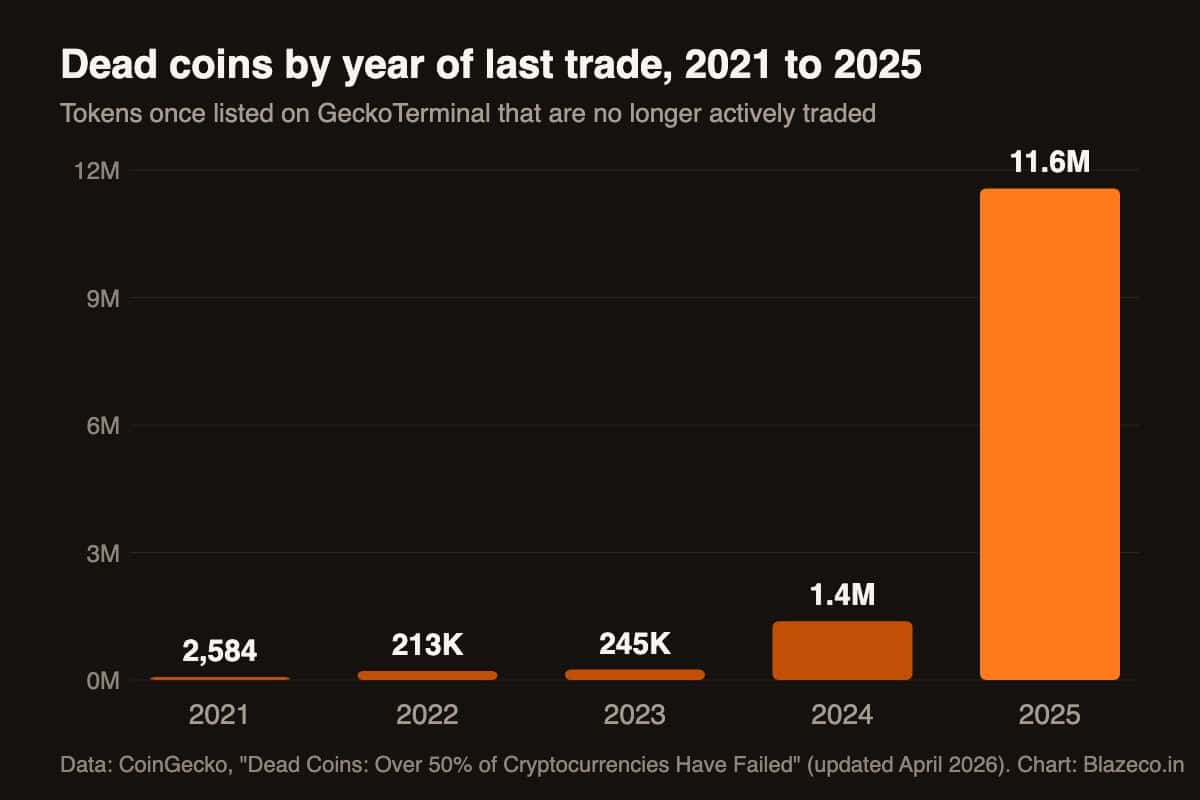
Dead coins by year
CoinGecko groups each dead coin by the year of its last active trade. The jump after 2023 is the story of the data.
| Year of last trade | Dead coins |
|---|---|
| 2021 | 2,584 |
| 2022 | 213,075 |
| 2023 | 245,049 |
| 2024 | 1,382,010 |
| 2025 | 11,564,909 |
Before pump.fun launched in 2024, yearly failures were in the low six digits. Failures from 2021 to 2023 add up to only 3.4% of the five-year total. 2024 accounts for 10.3%, and 2025 for 86.3%.
What counts as a dead coin?
In CoinGecko’s study, a coin counts as dead, or failed, when it was once listed on GeckoTerminal and is no longer actively traded. The data runs from 1 July 2021 to 31 December 2025, so coins that died earlier, such as many from the 2014 altcoin wave, are not in these figures at all.
That definition is about trading, not code. A coin can still have a website, a running node somewhere and a social account, and still count as dead because nobody buys or sells it. The reverse also happens: a coin with a few trades can look alive while its developers left years ago.
Why did so many coins fail in 2025?
CoinGecko gives two reasons. First, launchpads made it easy to create a token, which brought a flood of low-effort meme coins and projects. Second, the market turned. It links the fourth-quarter collapse to the turbulence after the 10 October 2025 “liquidation cascade”, when $19 billion in leveraged positions were wiped out in 24 hours.
That is a different kind of failure from the 2014 era. Coins like Blazecoin and the others in our guide to the scrypt algorithm ran their own blockchains, with wallets and mining pools. The tokens behind CoinGecko’s 2025 count were launched on launchpads that let anyone create one.
How to tell if a crypto coin is dead
No single signal is enough. Work through these checks in order and write down the date of each one.
- Look for recent trades. Open the coin on a price tracker and check the date and size of its latest trades, not just the last price shown.
- Check where it trades. Visit each exchange the project lists. If the exchange has closed or no longer lists the coin, that market is gone.
- Check the code. Open the project’s public repository and note the date of the last update, and whether the README warns users off.
- Check the chain. For a coin with its own blockchain, a block explorer should show new blocks being found. For a token, look for recent transfers on its contract.
- Check who runs the website. Domains change hands. Read the about page and the footer before trusting anything a site says about a coin.
Worked example: Blazecoin
Blazecoin was a scrypt fork of Litecoin that launched on 23 May 2014 to raise money for volunteer fire departments. Applying the checks above:
- Trades: a search of CoinGecko’s coin list for Blazecoin returns no result, so there is no tracked market for it.
- Exchanges: the two exchanges that listed it in 2014, Cryptoine and Coin-Swap, no longer run at their old addresses.
- Code: its GitHub repository was last updated on 21 January 2016, and its README tells people not to download the code while coin control is being redone.
- Website: blazeco.in is now an independent site that documents the project, not the project itself.
By every check, Blazecoin is a dead coin, and it dates from well before the period CoinGecko measured. Its full story, specs and sources are in the Blazecoin history.
What to do if you hold a dead coin
Start by confirming the facts with the checks above. If there is no exchange and no recorded trade, there is no market to sell into, whatever a price page last showed.
Be careful with anyone who contacts you offering to buy or recover a dead coin, or asking for your wallet’s recovery phrase. A dead coin has no team left to help, and nobody legitimate needs your recovery phrase.
Dead coins FAQ
How many cryptocurrencies have failed?
CoinGecko counts 53.2% of the cryptocurrencies once listed on its GeckoTerminal tracker as failed. That is about 13.4 million dead coins between mid 2021 and the end of 2025, 11.6 million of them in 2025 alone.
What counts as a dead coin?
In CoinGecko's study, a coin is dead or failed when it is no longer actively traded. Each one is grouped by the year of its last active trade.
Why did so many coins fail in 2025?
CoinGecko points to two things: launchpads made it easy to create low-effort meme coins, and the 10 October 2025 liquidation cascade wiped out $19 billion of leveraged positions in 24 hours.
Is Blazecoin a dead coin?
By the same test, yes. Blazecoin launched in May 2014, its code was last updated in January 2016, and neither exchange that listed it still runs at its old address.
Can I still sell a dead coin?
Only if someone still trades it. If no exchange lists the coin and no trades are recorded, there is no market to sell into, whatever a price page last showed.
Sources: CoinGecko, “Dead Coins: Over 50% of Cryptocurrencies Have Failed”, updated 17 April 2026; Blazecoin’s GitHub repository and its 2014 website via the Wayback Machine; our own check of the 2014 exchange addresses. All checked 17 November 2026. Nothing here is financial advice. Header photo: Shixart1985, Wikimedia Commons, CC BY 2.0, cropped. More from Blazeco.in: journal, home.